
Dog Food Calculator: How Much Food Should I Feed My Dog?
Use Pawtify’s free Dog Food Calculator guide to estimate daily portions in cups, grams, cans, or pouches using your dog’s calorie target and food label.
12 min read
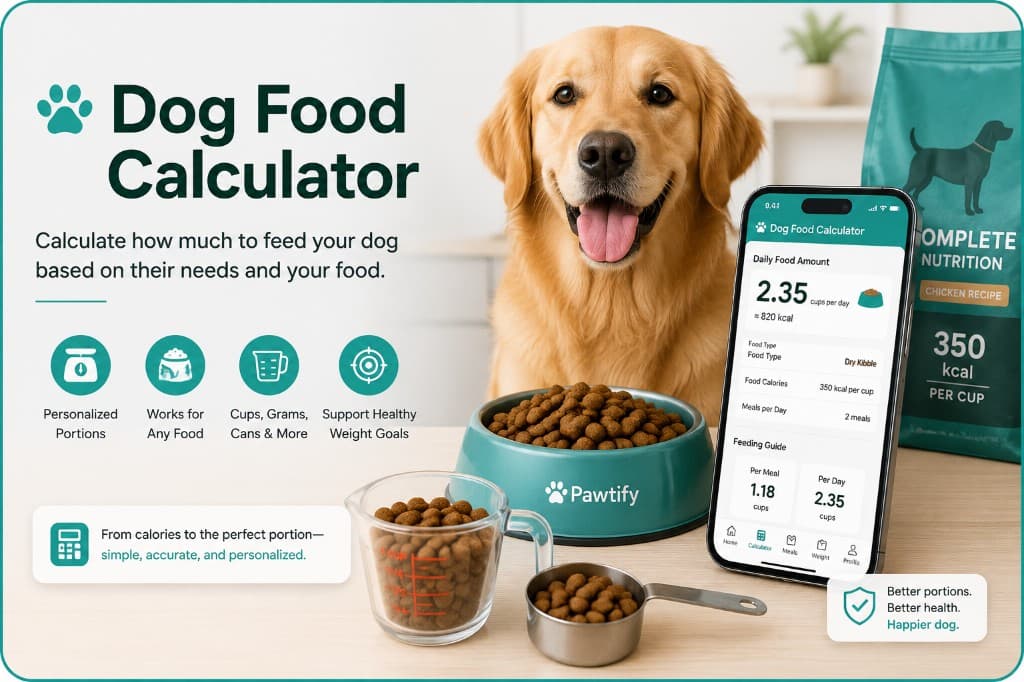
Use Pawtify’s Dog Food Calculator approach to estimate how much dry, wet, fresh, raw, or mixed food your dog may need each day. Enter your dog’s calorie target and the calorie information from the food label to calculate practical portions in cups, grams, cans, pouches, or meals.
This guide focuses on one question:
How much actual food should I feed?
If you still need a calorie number first, estimate your dog’s daily calorie needs with the Dog Calorie Calculator, then come back here to convert that target into servings.
Try the Dog Food Calculator method →
Dog Food Calculator vs Dog Calorie Calculator
These tools answer different questions. Keeping them separate helps you get a clearer feeding plan.
| Tool | Main question | Main output |
|---|---|---|
| Dog Calorie Calculator | How many calories does my dog need? | kcal per day |
| Dog Food Calculator | How much food should I serve? | cups, grams, cans, pouches, or meal servings |
In short:
- Calorie calculator → energy target
- Food calculator → portion size of a specific food
For background on why calorie targets vary by weight and activity, see How Many Calories Does My Dog Need?.
How the Dog Food Calculator Works
A Dog Food Calculator depends on two values:
- Your dog’s estimated daily calorie target (kcal/day)
- The food’s calorie density from the label (kcal per cup, gram, can, pouch, or tray)
Core formula:
Daily food amount = daily calorie target ÷ food calorie density
Examples:
- Cups per day = daily kcal ÷ kcal per cup
- Grams per day = daily kcal ÷ kcal per gram
- Cans per day = daily kcal ÷ kcal per can
- Pouches per day = daily kcal ÷ kcal per pouch
This is an estimate and a starting point. Real-world portions may need fine-tuning as you monitor weight, stool quality, and energy.
Information Needed Before Calculating
Gather these details before you run the numbers:
- Daily calorie target from the Dog Calorie Calculator or your veterinarian
- Food type (dry, wet, fresh, raw, or mixed)
- Label calorie density (kcal per cup, can, pouch, tray, 100 g, or kg)
- Number of meals per day
- Treat and dental chew calories, if known
- Current weight trend (losing, gaining, or stable)
If your dog is on a prescription diet or has a medical condition, ask your veterinarian before changing portions.
Dry Food Calculations
Dry kibble labels often list:
- kcal per cup
- kcal per kg
- sometimes kcal per 100 g
Cups per day
Cups per day = daily kcal ÷ kcal per cup
Example:
- Target: 700 kcal/day
- Food: 350 kcal/cup
- Result: 2.0 cups per day
Grams per day
If the bag lists kcal per kg:
- kcal per gram = kcal per kg ÷ 1,000
- grams per day = daily kcal ÷ kcal per gram
Example:
- Target: 700 kcal/day
- Food: 3,500 kcal/kg
- kcal per gram = 3.5
- Result: 200 g per day
Household mugs are not measuring cups. Use a true 8 oz measuring cup or a kitchen scale for more consistent portions.
Wet Food Calculations
Wet foods usually list calories per can, pouch, or tray.
Cans (or pouches) per day = daily kcal ÷ kcal per container
Example:
- Target: 760 kcal/day
- Food: 190 kcal/can
- Result: 4.0 cans per day
If a can is 12.5 oz and you split meals, you may serve part-cans. A kitchen scale helps when the math does not land on neat whole containers.
Fresh Food Calculations
Fresh diets often list:
- kcal per 100 g
- kcal per package
- suggested daily grams by recipe
If a fresh food is 150 kcal per 100 g:
- Target: 1,200 kcal/day
- kcal per gram = 1.5
- Result: 800 g per day
Always confirm whether the package calories assume the full formula as fed, and whether toppers or mix-ins are already counted.
Raw Food Calculations
Some raw feeding guides use a percentage of body weight. That can be a rough starting point, but it is not calorie-aware.
Better approach:
- Estimate daily kcal needs
- Use the raw recipe’s kcal density
- Convert to grams or ounces
- Confirm the diet is complete and balanced for your dog’s life stage
Raw feeding is not universally appropriate. Dogs with medical conditions, puppies, and households with immune-compromised people should get veterinary or veterinary-nutrition guidance before using raw diets.
Mixed Feeding Calculations
When you combine foods, split the calorie budget first, then convert each share.
Example:
- Daily target: 800 kcal
- Dry food: 400 kcal/cup
- Wet food: 200 kcal/can
- Plan: 50% of calories from each food
Allocation:
- Dry: 400 kcal → 1.0 cup
- Wet: 400 kcal → 2.0 cans
If treats will add 80 kcal, reduce the meal budget to 720 kcal before splitting foods.
Practical Food Portion Examples
Example 1: Small dog eating kibble
- Daily target: 420 kcal
- Food: 350 kcal per cup
- Result: 1.2 cups per day
- Two meals: about 0.6 cups per meal
Example 2: Medium dog eating wet food
- Daily target: 760 kcal
- Food: 190 kcal per can
- Result: 4 cans per day
- Two meals: 2 cans per meal
Example 3: Large dog eating fresh food
- Daily target: 1,200 kcal
- Food: 150 kcal per 100 g
- Result: 800 g per day
- Two meals: 400 g per meal
Example 4: Mixed feeding
- Daily target: 900 kcal
- Dry: 360 kcal/cup
- Wet: 180 kcal/can
- Split: 60% dry / 40% wet
Results:
- Dry allocation: 540 kcal → 1.5 cups
- Wet allocation: 360 kcal → 2 cans
Round only when needed for practical measuring, then watch your dog’s weight over 2–4 weeks.
Example Dry Food Portion Table
This table is an example only, assuming dry food at 350 kcal per cup. Your bag may differ.
| Daily calorie target | Approx. cups per day (350 kcal/cup) |
|---|---|
| 250 kcal | 0.7 cup |
| 400 kcal | 1.1 cups |
| 600 kcal | 1.7 cups |
| 800 kcal | 2.3 cups |
| 1,000 kcal | 2.9 cups |
| 1,200 kcal | 3.4 cups |
| 1,500 kcal | 4.3 cups |
Always recalculate with the kcal per cup printed on your specific food.
How to Read a Dog Food Label for Calories
Look for metabolizable energy (ME) information. Common formats include:
- kcal per cup
- kcal per can / pouch / tray
- kcal per kg
- kcal per 100 g
- serving size notes
- guaranteed analysis (protein, fat, fiber, moisture)
Convert kcal per kg to kcal per gram
kcal per gram = kcal per kg ÷ 1,000
Then:
grams per day = daily kcal target ÷ kcal per gram
Why label reading matters
Two kibbles can both say “feed 2 cups,” yet one may be 300 kcal/cup and another 450 kcal/cup. Portion charts on the bag are generalized. Your dog’s target plus the food’s density gives a more personalized estimate. For broader label and food-type guidance, see the pet food guide.
Common Feeding Mistakes
Avoid these frequent portion problems:
- Using a coffee mug instead of a measuring cup
- Ignoring treats, toppers, and dental chews
- Assuming every kibble has the same calories per cup
- Following only the package chart without personalization
- Not adjusting after weight or activity changes
- Multiple people feeding the same dog without a shared plan
- Switching foods without recalculating density
- Confusing grams of food with calories
- Rounding so aggressively that portions drift week to week
- Changing several variables at once (food, treats, and exercise)
How to Split Food Across Meals
Once you know the daily amount, divide it across meals.
Example: 2.4 cups per day
- 1 meal: 2.4 cups
- 2 meals: 1.2 cups each
- 3 meals: 0.8 cups each
Puppies often do better with more frequent meals. Adults commonly eat once or twice daily. There is no single schedule that fits every dog—use your veterinarian’s advice for puppies, seniors, and medical cases.
When to Recalculate Portions
Recalculate when:
- You change foods or flavors with different calorie density
- Your dog’s weight rises or falls unexpectedly
- Activity level changes for more than a couple of weeks
- Your dog becomes pregnant, nursing, or newly senior
- Treat intake changes substantially
- Your veterinarian sets a weight-loss or weight-gain plan
A stable dog still benefits from monthly weight checks. For ongoing logging habits, see pet meal calorie tracking and health progress tracking.
Turn a Feeding Estimate Into a Daily Routine
Once you know your dog’s portion, Pawtify helps you scan meals, track calories, monitor weight changes, and keep feeding history in one place.
The free web estimate is a one-time calculation. The Pawtify app supports day-to-day routines with AI meal scanning, personalized pet profiles, nutrition insights, and history you can review over time.
Frequently Asked Questions
How much food should I feed my dog?
Start with a daily calorie estimate, then divide by your food’s calorie density to get cups, grams, cans, or pouches. Adjust based on weight trends and veterinary guidance.
How do I calculate dog food portions?
Use: daily food amount = daily calorie target ÷ food calorie density.
How many cups of food should my dog eat?
It depends on kcal per cup for that recipe, not just your dog’s weight. Always use the label for the food you are feeding.
Is a Dog Food Calculator the same as a Dog Calorie Calculator?
No. One estimates calories needed. The other converts those calories into a serving of a specific food.
How do I find calories per cup on a dog food label?
Check the metabolizable energy section. Dry foods often list kcal/cup; wet foods often list kcal per can, pouch, or tray.
Can I use the calculator for wet food?
Yes—divide daily kcal by kcal per can, pouch, or tray.
Can I use it for fresh or raw food?
Yes if calorie density is known. Raw diets need extra care for balance and safety; ask your veterinarian when unsure.
How do I calculate mixed feeding?
Split the calorie target between foods, then convert each share with that food’s density.
Should treats be included?
Yes. Count treats and chews in the daily budget so meal portions stay accurate.
How often should I recalculate portions?
Anytime food, weight, activity, life stage, or treat habits change.
Can I use this calculator for puppies?
The math is the same, but puppy targets and meal frequency differ. Confirm with your veterinarian.
Can I use this calculator for senior dogs?
Yes. Recalculate when metabolism, mobility, or diet changes.
Why does my dog’s food amount differ from the package chart?
Package charts are averages. Individual dogs and recipes vary.
Can this calculator replace veterinary advice?
No. These are educational estimates only.
Related Tools and Articles
- Dog Calorie Calculator — estimate kcal per day
- How Many Calories Does My Dog Need? — calorie needs guide
- Pet Food Guide — choosing food and reading labels
- Pet Meal Calorie Tracking — logging meals over time
- Cat Calorie Calculator — calorie estimates for cats
- AI Pet Care Guide — how AI meal scanning supports everyday care
Ready to put the numbers to work? Calculate daily calories, convert them into portions with the method above, then track meals with Pawtify.
Veterinary Disclaimer
This calculator guide and article provide educational estimates only. Dogs with medical conditions, pregnancy, lactation, rapid weight changes, therapeutic diets, or complex nutrition needs should be evaluated by a veterinarian or veterinary nutritionist.
Ready to care smarter?
Download Pawtify to start scanning, tracking, and building better wellness habits for your pets.